
By Watch World Media | June 2026
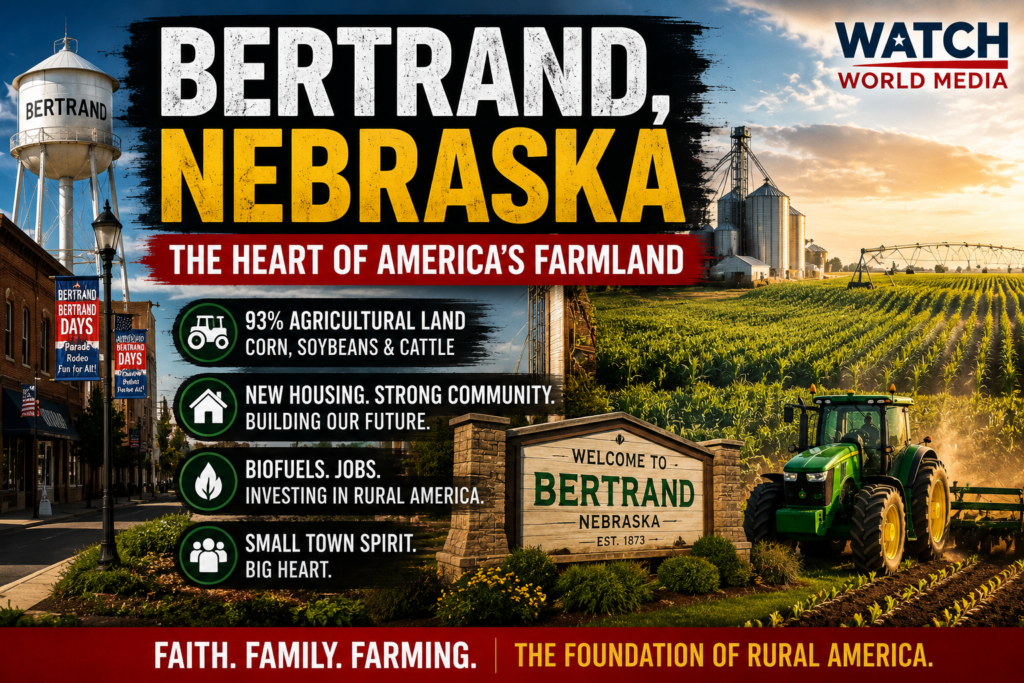
Nestled in the agricultural heartland of south-central Nebraska, the village of Bertrand stands as a living example of traditional rural America. Surrounded by vast stretches of cornfields, soybean farms, and cattle operations, the community of roughly 750 residents continues to demonstrate resilience in the face of changing economic, demographic, and agricultural realities.
Located in Phelps County, one of Nebraska’s most productive agricultural regions, Bertrand offers a glimpse into a way of life that remains deeply connected to the land. Grain elevators dominate the skyline, farm equipment moves steadily along country roads, and local events continue to bring neighbors together in a community where agriculture remains both an economic engine and a cultural foundation.
A County Built on Agriculture
Phelps County has approximately 93 percent of its land dedicated to agricultural use, making farming and ranching the backbone of the local economy.
Corn and soybean production dominate much of the landscape, while cattle operations contribute significantly to the region’s agricultural output. Like many farming communities across the Great Plains, producers have faced challenges from fluctuating commodity prices, rising input costs, and unpredictable weather conditions.
Nebraska’s farmland market has experienced modest declines in value after reaching record highs in recent years. However, strong cattle prices and improved farm income projections have helped offset some of the pressure facing crop producers.
State economists project Nebraska farm income could approach record levels in 2026, supported by livestock performance, government support programs, and expectations of improved crop conditions.
Challenges Facing Rural Communities
Despite its agricultural strength, Bertrand faces many of the same challenges confronting rural communities across America.
Population growth remains difficult, young residents often leave for educational and career opportunities elsewhere, and small towns continue competing for businesses and workforce talent.
Farm consolidation trends have also altered the rural landscape, reducing the number of family-operated farms while increasing the scale of agricultural operations.
Weather-related concerns remain constant as well. Dry conditions, grass fires, and other natural hazards can quickly affect both crops and livestock. Earlier this year, a major grass fire near Bertrand drew attention throughout the region and highlighted the vulnerability of rural communities to environmental risks.
Housing Success Brings New Momentum
One of Bertrand’s most significant recent achievements has been its effort to address housing shortages.
After more than a decade and a half without new residential construction, the community completed the Sunset View Villas housing project in 2024. The development has provided much-needed housing for teachers, manufacturing employees, agricultural workers, and other residents.
Local leaders credit the project with helping stabilize population numbers and encouraging additional private investment in housing renovations throughout the village.
The success of these initiatives earned recognition through a Nebraska Affordable Housing Trust Fund award in 2026 and has become a model for other rural communities facing similar challenges.
Investing in the Future
Community leaders continue seeking ways to strengthen Bertrand’s long-term prospects.
Educational programs focused on skilled trades, local mentorship opportunities, recreational investments, and community events all play a role in encouraging young residents to remain connected to the area.
Meanwhile, broader economic developments within Phelps County are creating new opportunities. The advancement of sustainable aviation fuel projects and other bio-economy investments could provide additional markets for agricultural products while generating jobs and economic activity.
These initiatives reflect a growing effort to diversify rural economies without abandoning the agricultural heritage that defines communities like Bertrand.
Community Spirit Remains Strong
Perhaps Bertrand’s greatest asset is its sense of community.
Events such as Bertrand Days continue to bring together residents, former residents, farmers, business owners, and visitors in celebrations that highlight local traditions and values. Volunteer organizations, schools, churches, and civic groups remain central to daily life.
While economic uncertainty, demographic shifts, and agricultural volatility continue to present challenges, many residents remain optimistic about the future.
In an era when rural communities are often portrayed as declining, Bertrand offers a different story — one of adaptation, perseverance, and a commitment to preserving the values that have sustained generations of farming families.
For many Americans, communities like Bertrand remain a reminder that the nation’s agricultural heartland continues to play a vital role in feeding the country, supporting local economies, and preserving a uniquely rural way of life.
Watch World Media