

VDBView:
Reported by Watch World Media
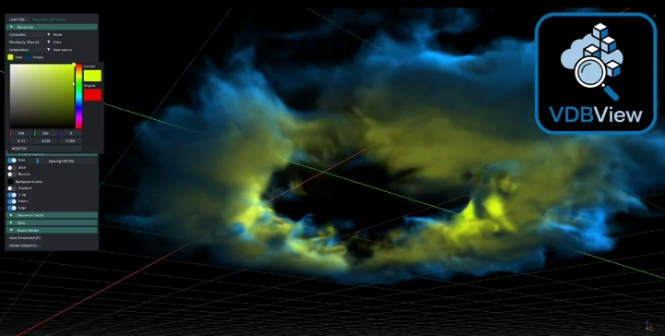
ATLANTA, GEORGIA — In the increasingly complex world of visual effects production, where simulation-heavy workflows often rely on resource-intensive software, veteran VFX artist has introduced a lightweight utility designed to streamline one specific part of the pipeline: viewing OpenVDB files.
The tool, called VDBView, was shared publicly by Key on social media in late May 2026 as a free personal project aimed at simplifying the inspection and playback of volumetric simulation data.
A Practical Utility for VFX Pipelines
OpenVDB has become a widely adopted industry standard for storing sparse volumetric data used in effects such as smoke, fire, clouds, explosions, and fluid simulations. These files are commonly generated in software packages including Houdini, Blender, Maya, and real-time simulation tools.
While creating VDB simulations is well supported across the industry, quickly previewing or reviewing those files often requires launching full digital content creation (DCC) applications or rendering environments, which can add time and system overhead during production workflows.
VDBView attempts to address that gap by offering a standalone viewer focused specifically on VDB inspection and playback.
According to Key’s public demonstrations and feature breakdowns, the application is designed to run independently without requiring installation of larger 3D software suites.
Background on the Creator
Key brings decades of experience in computer graphics and visual effects. He currently works as a VFX Artist and Evangelist at , the studio behind simulation tools such as EmberGen and LiquiGen.
His background spans film, games, advertising, and product visualization, with a focus on lighting, compositing, and effects workflows.
In announcing the project publicly, Key described VDBView as a personal side project developed to solve workflow frustrations encountered during everyday production work.
Core Features
Based on publicly available demos and documentation, VDBView currently includes:
- Real-time 3D viewport navigation
- Multi-grid visualization controls for channels such as density and velocity
- Sequence playback and caching for animated VDB files
- Basic lighting and shading tools
- Blackbody emission rendering for fire simulations
- Cross-section slicing tools
- Velocity streamline visualization
- Level-set surface rendering
- Screenshot and PNG sequence export support
- Basic command-line rendering functionality
The software appears designed primarily for quick review, debugging, look development, and educational use cases rather than full-scale rendering or simulation authoring.
AI-Assisted Development
In follow-up social media discussions, Key noted that aspects of the software’s development were assisted using AI coding tools, including Anthropic’s Claude models.
The approach reflects a broader trend within technical and creative industries, where experienced developers and artists are increasingly combining domain expertise with AI-assisted prototyping to accelerate smaller-scale software projects.
Community Reception
The release received positive engagement across portions of the VFX and simulation community online, particularly among artists who regularly work with volumetric assets.
Users responding to the project highlighted the potential convenience of a dedicated lightweight viewer compared to opening larger applications for simple inspection tasks.
At the same time, some industry observers noted that the long-term usefulness of tools like VDBView will likely depend on continued updates, broader format compatibility, platform stability, and adoption within professional production environments.
Broader Industry Context
The release of VDBView comes at a time when many artists and smaller studios are seeking more focused and efficient utilities that reduce dependency on large software ecosystems for routine tasks.
While enterprise-grade VFX software remains central to professional pipelines, lightweight companion tools have become increasingly common for asset review, automation, and rapid iteration.
Projects like VDBView also illustrate how individual developers and artists can contribute practical solutions to niche workflow challenges without necessarily pursuing large-scale commercialization.
Availability
VDBView is currently being distributed free of charge through its official website and associated social media links shared by the creator.
As with any independently distributed software, users are generally encouraged to verify download sources and review compatibility information before installation.
Reporting from Atlanta, Georgia, this is Watch World Media.
Watch World Media will continue bringing coverage on emerging creative technologies, digital production tools, and innovation across the media and entertainment industries.
Temporary sponsored visibility provided by Watch World Media. Businesses interested in permanent promotion can subscribe at https://watchworldmedia.com/sponsorship/
For article updates, corrections, or inquiries, kindly contact mediawatchworld@gmail.com